
Analyzing the plain language of the statute, Mr. Ramos did not fire the shot “at or into” an occupied structure.
State v. Ramos
Eleventh District Appellate Court
Trumbull County, Ohio
June 15, 2026
Why is this case important?
State v. Ramos underscores that criminal statutes are strictly construed according to their plain language and that courts may not broaden the reach of a criminal statute based upon the dangerousness of a defendant’s conduct.
For prosecutors and law enforcement officers, Ramos serves as an important reminder that the facts must satisfy every statutory element before charges are filed. When the legislature chooses different words in different subsections of the same statute, courts presume those differences were intentional.
Mr. Ramos Refuses to Let Ms. Speakman Leave with Her Purse
On February 23, 2025, Kaitlyn Speakman, Mr. William Ramos’ ex-girlfriend, was at the apartment Mr. Ramos shared with a third party. Ms. Speakman remained friends with Mr. Ramos even though they were not dating at the time of the incident. That day, Ms. Speakman attempted to leave Mr. Ramos’ apartment, but he objected. He did not want Ms. Speakman to leave and would not allow her to take her purse. Ms. Speakman eventually left the apartment without the purse.
Ms. Speakman Returns to Retrieve her Purse with Her Door Dash Partner
Later that evening, Ms. Speakman and a friend, Calvin Johnson, were “Door-dashing” to make some extra money. Mr. Johnson had a Dodge Charger that he transported himself and Ms. Speakman to accommodate Door-dash clients. Ms. Speakman, however, needed her purse to give Mr. Johnson money for driving. They consequently returned to Mr. Ramos’ apartment to retrieve Ms. Speakman’s purse.
Mr. Ramos Retrieves a 12-Gauge Shotgun
Ms. Speakman entered the apartment building, which included six, discrete units. Mr. Ramos asked Ms. Speakman who she was with and, when she told him Mr. Johnson drove her to the apartment, Mr. Ramos threatened to shoot both individuals. Ms. Speakman continued to ask for her purse, but Mr. Ramos refused to return the item. She tried to leave the apartment but was blocked by Mr. Ramos. She eventually sat down on a couch, at which point Mr. Ramos retrieved a 12-gauge shotgun and stood at the threshold of the apartment with the door opened. Ms. Speakman stated she “wasn’t really shocked when he pulled [the shotgun] out.” Nevertheless, she stated “[a]re you really going to do this? Like, stop.”
Mr. Ramos Shot from his Apartment Down the Common Hallway to the Building’s Front Door
Mr. Ramos fired one shot from the 12 gauge in a direction which struck the outside of the entrance/exit door to the building. Police later found buck-shot evidence in the wall and/or door frame of the entrance/exit door. Critically, Ms. Speakman testified that at the time of the discharge, Mr. Ramos had extended the gun into the common hallway of the building—not merely standing at the threshold of his apartment unit. Specifically, Ms. Speakman testified “he went to the door . . . [a]nd then shot off the gun . . . with his arm out the door to the front door towards the front door.” The gun was therefore already inside the hallway of the building when the shot was fired. It is uncontroverted he did not shoot at another apartment, nor did he aim at Ms. Speakman.
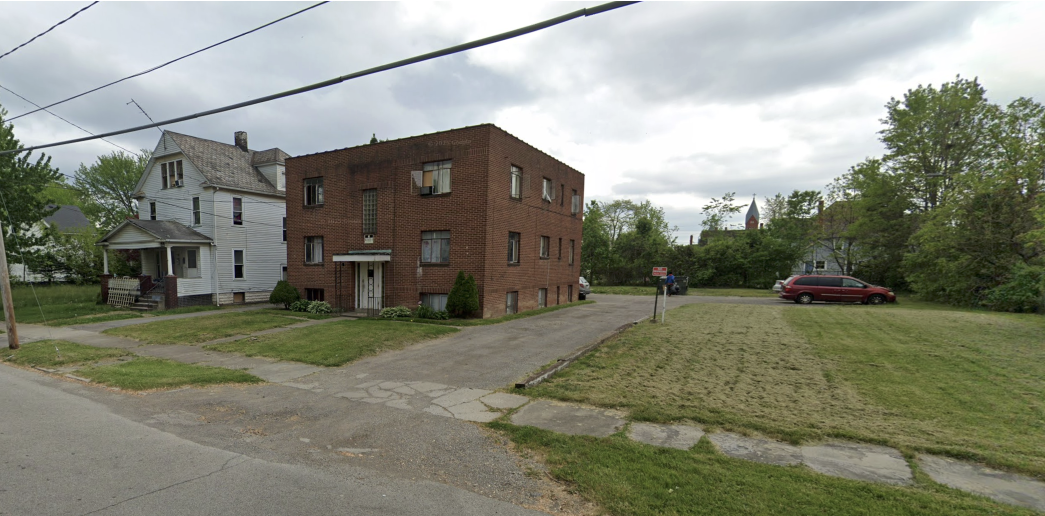
Mr. Ramos lived here at 300 Scott Street NE, Warren, Ohio in Apartment #4. When Mr. Ramos shot his shotgun blast from inside towards the front door … was that Improperly Discharging a Firearm at or Into a Habitation?
Ms. Speakman and Mr. Johnson Left
With or Without the Purse?
After discharging the shotgun, Mr. Ramos walked away from the apartment’s front door, and Ms. Speakman left in the vehicle with Mr. Johnson. An unidentified individual called police reporting “shots fired” in the apartment building.
Police Begin to Investigate
The police department responded to the call. When the officer arrived at the building, he observed a vehicle leaving the apartment building. The vehicle was ultimately stopped by another officer. Mr. Johnson was the driver, and Ms. Speakman was the passenger. Both were questioned about the incident.
Note: The police department and officer are identified in the case but are omitted in this article.
The Officer Discovers the Shotgun
The officer proceeded into the apartment building. He located Mr. Ramos’ apartment and knocked on the door but received no response. The officer decided to enter the apartment and observed another tenant in the living area. Mr. Ramos, who was in the shower, eventually appeared. A search of the room in which Mr. Ramos was staying revealed a 12-gauge shotgun which had a spent shell casing in it.
The Officer Discovers the Evidence of the Shotgun Blast
The officer observed “wadding” and “bullet holes . . . from buckshot or little BBs” on the inside of the entrance/exit door to the building. There was no evidence that any shot was fired from outside of the building.
Mr. Ramos was indicted on one count of Improperly Discharging a Firearm
Mr. Ramos was indicted on one count of improperly discharging a firearm at or into a habitation, in violation of O.R.C. §2923.161(A)(1) and (C), a felony of the second degree, and two counts of aggravated menacing, in violation of O.R.C. §2903.21(A) and (B), misdemeanors of the first degree.
Judge Denies Plea Agreement to Aggravated Menacing
Mr. Ramos pleaded not guilty to the charges. The State offered a plea agreement wherein Mr. Ramos would plead guilty to the two aggravated menacing counts (one against Ms. Speakman and one against Mr. Johnson). The trial court, however, rejected the proposed plea stating: “No. No. That’s not going to happen when a gun is used in an apartment where people are living. You’re not pleading to aggravated menacing in this court.” At this hearing, defense counsel moved to dismiss the discharging-firearms count, arguing the State lacked prima facie evidence to proceed on that count given the plain language of the statute. The State conceded that the only evidence it had was Mr. Ramos discharging a firearm from the hallway, outside of his apartment and not into another apartment from the outside of the building. The trial court denied the motion.
Court Determines that Mr. Ramos’ Actions could have Seriously Injured or Killed Someone in the Hallway
On June 5, 2025, the trial court issued its judgment overruling the joint motion to dismiss the discharging-firearms count. The trial court acknowledged Mr. Ramos “fired a shotgun while inside the doorway of the apartment building when the shot was fired.” The trial court determined that Mr. Ramos “fired the shotgun from inside the doorway of the apartment, however, he also fired the shot ‘at or into an occupied structure’ as the shot went into the hallway of an apartment building that is occupied by others. An occupant of the apartment building could have been killed or seriously injured had they entered that hallway.”
Defense – Firearm was Never Pointed at a Specific Apartment from Inside the Apartment Building
On June 6, 2025, the State moved the trial court, in writing, for reconsideration of its judgment denying the motion for dismissal. The motion was apparently orally joined by the defense. In its written motion, the State emphasized that Mr. Ramos’ “gun was never pointed at an individual. The gun was never pointed at a specific apartment. The gun was shot from [Mr. Ramos’] premises from inside to the door leading outside the apartment building.” Under the circumstances, the State submitted that “the statute, and legislative intent are contrary to the evidence in this case thus the State reasonably believes it would be unable to legally prove [Mr. Ramos’] guilt by proof beyond a reasonable doubt at trial as to Count [One] of the indictment.”
Trial Court Judge Punts Statute Interpretation to Appellate Court
After holding a hearing on the motion to reconsider, the trial court overruled the motion. The trial court, from the bench, stated:
I think that’s an issue for the Court of Appeals to deal with, whether there was legislative intent and whether – – my personal feeling is that I don’t know what world we live in if we can shoot out of an apartment into the entry and not have some sort of culpability in the crime. I don’t know if it fits this particular statute, but that’s something for the Court of Appeals to deal with.
Trial
The matter proceeded to jury trial, at which the State presented evidence from Ms. Speakman and the officer. At the conclusion of the State’s case, Mr. Ramos, via counsel, moved for acquittal on all counts. The trial court granted the motion as to the aggravated menacing count pertaining to Mr. Johnson. The trial court, however, overruled the motion on the remaining aggravated-menacing count pertaining to Ms. Speakman and the improperly-discharging-a-firearm count. Specifically, the trial court determined:
Regarding the firearm, improperly handling a firearm by shooting in or at the habitation, this court considers the other cases that you’ve spoken of as distinctively different because the majority of those were standalone homes. You know, you can use a gun and shoot in your own home outside in the yard or inside. But it’s very different when, one, there’s a tenant in his own apartment – – in the apartment that Mr. Ramos is staying at. I don’t know if he has any legal interest in that property at all.
He was staying at that bedroom for that day, from what – – is all the evidence I heard, with his girlfriend. And there was evidence that he went and took a shotgun, went to the hallway of his apartment – – of that apartment unit, and then shot into the hallway of the apartment building, which has six units. And I consider the hallway of the apartment building also part of the habitation of the individuals who live there, including the legal tenant of the property that [Mr. Ramos] was in, as well as the other units.
He shot at the front door, which is also an exit door. The bullet was found – – or bullet fragments were found, the wad, at the exit door. The shotgun was found. It was examined. I think there’s sufficient evidence for that to go to the jury.
Mr. Ramos Found Guilty of Improperly Discharging a Firearm and Sentenced to Two to Three Years in Prison
After closing arguments and the trial court’s jury instructions, appellant was acquitted of the aggravated menacing charge against Ms. Speakman but found guilty of the improperly-discharging-a-firearm count. The trial court ordered a presentence investigation report and ultimately sentenced Mr. Ramos to an indefinite prison term of two years and a maximum of three years.
This appeal follows.
Mr. Ramos assigns the following as error:
“Appellant’s conviction was not supported by sufficient evidence.”
Mr. Ramos was indicted for violating O.R.C. §2923.161, which provides, in pertinent part: (A) No person, without privilege to do so, shall knowingly do any of the following: (1) Discharge a firearm at or into an occupied structure that is a permanent or temporary habitation of any individual. . . .
Mr. Ramos challenges the State’s failure to produce evidence that he knowingly, without privilege to do so, discharged a firearm at or into an occupied structure. After reviewing the caselaw and the statutory language in full context, we agree with Mr. Ramos.
Legislative Intent
At first, it would appear that Mr. Ramos’ act of firing his shotgun in the direction of the common area of his apartment residence could meet the requirements of the prepositions “at” or “into” in the disjunctive phrase “at or into” included in the indicted charge. A closer examination of the statute in its entirety, however, demonstrates the legislature’s intention to criminalize the discharge of a firearm when it is shot from the outside of an occupied structure and therefore the “at or into” element is not (necessarily) met when one shoots from inside of an occupied structure.
Legislative Interpretation
Mr. Ramos points out that O.R.C. §2923.161(A)(2), the subsection immediately following the section with which he was charged, provides that no person, without privilege, shall knowingly “[D]ischarge a firearm at, in, or into a school safety zone. . . .” He underscores that the inclusion of the preposition “in,” under subsection (A)(2), demonstrates the legislature’s intention to criminalize the discharge of the crime proven beyond a reasonable doubt.” State v. Troisi, 2008-Ohio-6062, ¶ 9 (11th Dist.). “‘Sufficiency of the evidence a firearm that actually takes place inside a school safety zone. The General Assembly’s decision not to utilize the word “in” under subsection (A)(1), evinces an intent, therefore, not to criminalize the discharge of a firearm from inside an occupied structure that would otherwise meet the other elements of the crime.
By using specific language in subsection (A)(2), but omitting that language from (A)(1), Mr. Ramos argues the legislature unequivocally drafted the statute to specifically require any charge under subsection (A)(1) be supported by evidence that the defendant discharged the firearm from outside an occupied structure. In other words, by employing certain language in one instance, and different language in another, the legislature indicated different results were intended.
Established Case Law – Statutory Interpretation
“The primary goal of statutory construction is to ascertain and give effect to the legislature’s intent in enacting the statute.” State v. Lowe, 2007-Ohio-606, ¶ 9, citing Brooks v. Ohio State Univ., 111 Ohio App.3d 342, 349 (10th Dist. 1996). “The court must first look to the plain language of the statute itself to determine the legislative intent.” Lowe at ¶ 9, citing State ex rel. Burrows v. Indus. Comm., 1997-Ohio-310, ¶ 10. We apply a statute as it is written when its meaning is unambiguous and definite. Portage Cty. Bd. of Commrs. v. Akron, 2006-Ohio-954, ¶ 52, citing State ex rel. Savarese v. Buckeye Local School Dist. Bd. of Edn., 1996-Ohio-291, ¶ 7. “An unambiguous statute must be applied in a manner consistent with the plain meaning of the statutory language.” Lowe at ¶ 9, citing Burrows at ¶ 10.
In light of the legislature’s use of different, additional language under subsection O.R.C. §2923.161(A)(2) that captures a separate actus reus than that criminalized under (A)(1), we conclude the latter subsection unambiguously contemplates an actus reus that, in most cases, including the instant matter, must occur outside an occupied structure. See footnote one below. This analysis finds support in other appellate districts.
Established Case Law – Statutory Interpretation of Discharge of a Firearm Into a Habitation
First, in State v. Nash, 2003-Ohio-230 (5th Dist.), the Fifth Appellate District was faced with a similar argument. In recognizing that subsection O.R.C. 2923.161(A)(1) limited its verbiage to the discharge of a firearm “at or into” an occupied structure, and subsection O.R.C. §2923.161(A)(2) used the more expansive language of “at, in, or into,” the court concluded subsection (A)(1) required evidence that the firearm was discharged from the outside of an occupied structure. Specifically, the court determined:
R.C. 2923.161(A)(1) prohibits an individual from discharging a firearm “at or into an occupied structure”. In contrast, subsection (A)(2) of R.C. 2923.161(A)(2) prohibits an individual from discharging a firearm “at, in or into” a school safety zone. (Emphasis added). Had the drafters of R.C. 2923.161 intended to prohibit discharging a firearm in a habitation, they could have, and presumably would have, included the same language in subsection (A)(1) as in (A)(2). The expression of one thing implies the exclusion of another (“expressio unius est exclusio alterius”). See, e.g., Green, Inc. v. Smith (1974), 40 Ohio App.2d 30, 32, 317 N.E.2d 227, 229. Since the word “in” is not contained in R.C. 2923.161(A)(1) and since there is no evidence that appellant discharged his firearm at or into a habitation, appellant’s conviction for improperly discharging a firearm at or into a habitation is against the manifest weight of the evidence. Nash at ¶ 17.
Similarly, in State v. Moorer, 2008-Ohio-2560 (1st Dist.), the appellate court, citing Nash with approval, concluded that reading the statute “as a whole” supports the conclusion that the plain language of subsection R.C. 2923.161(A)(1) requires “the proscribed conduct of ‘discharging a firearm’ must occur from outside the dwelling that is first fired ‘at or into.’” Moorer at ¶ 5 and 4 (respectively). The First District observed that it agreed with the court in Nash that the General Assembly could have included the word “in” under subsection (A)(1) but did not. Id. at ¶ 5. As such, the court determined that criminalizing conduct occurring inside an occupied dwelling was contrary to statutory intent. See Id. at ¶ 6.
“At or into” an occupied structure does not necessarily incorporate an act that occurs specifically “in” an occupied structure. In light of what O.R.C. §2923.161 is designed to criminalize (namely, the knowing discharge of a firearm under specific circumstances), we conclude that the legislature intended only to prohibit the discharge of a firearm, in cases such as this one, from the outside of an occupied dwelling. 1
What Does At or Into Mean?
This plain-meaning, which incorporates a directional reading of the phrase “at or into,” finds additional persuasive support in Commonwealth v. McCoy, 928 A.2d 306 (Pa. Super. 2007), aff’d in part, 962 A.2d 1160 (Pa. 2009). {¶32} In McCoy, the court applied the ordinary meaning of “into—“movement from outside to inside—and held that the defendant did not discharge a firearm “into” an occupied structure because he was already inside when he fired. (Justice Antonin Scalia and Bryan Garner cite McCoy with approval as an application of plain meaning to directional prepositions. A. Scalia & B. Garner, Reading Law: The Interpretation of Legal Texts 11–13 (2012)). The directional logic of McCoy applies equally here: the prepositions “at” and “into” in O.R.C. §2923.161(A)(1) require the discharge to originate from outside the occupied structure, and a shot cannot travel “at or into” a structure from a position already inside it.
What was the Nature of the Target by Mr. Ramos?
This conclusion is not altered by O.R.C. §2909.01(C)(4), which defines “occupied structure” to include “a portion of a building” in which any person is present or likely to be present. The trial court reasoned that the common hallway of the apartment building qualified as a portion of an occupied structure and that Mr. Ramos therefore discharged his firearm “at or into” that structure. This reasoning conflates two distinct elements of the offense. The definition of “occupied structure” governs the nature of the target—it identifies what qualifies as the structure at or into which the firearm must be discharged. The prepositions “at or into” govern the actus reus—the directionality of the discharge in relation to that structure.
Mr. Ramos fired the gun from within the same occupied structure he is alleged to have targeted.
Even, assuming arguendo, that the common hallway constitutes a “portion of” the occupied structure for definitional purposes, this does not alter the directional requirement imposed by the prepositions. Mr. Ramos fired the gun from within the same occupied structure he is alleged to have targeted. Indeed, as established by Ms. Speakman’s testimony, the gun was extended into and discharged from within the hallway itself—a portion of the structure that the State claims was the target of the discharge. The breadth of O.R.C. §2909.01(C)(4), which defines an “occupied structure,” expands what counts as the target; it does not relocate the shooter. These two components of the statute operate on separate elements of the offense and the plain-language application of both, read together, compels the same result.
Revisiting the Legal Punt Language
Two final points require attention. In overruling the joint motion to dismiss, the trial court first stated, “I don’t know what world we live in if we can shoot out of an apartment building into the entry and not have some culpability in the crime. I don’t know if it fits this particular statute, but that’s something for the Court of Appeals to deal with.”
The facts of this case do not fit within this specific statute.
A court applies the law as written and, even though Mr. Ramos’ actions were clearly problematic, they simply do not meet the elements of O.R.C. §2923.161(A)(1) under these facts. The facts of this case do not fit within this specific statute; it does not, however, imply that a different charge may have corresponded with the facts of this case.
We further note that the controlling factual distinction—the gun’s position inside the building’s common hallway at the moment of discharge—was not argued with particularity by either party in the trial court. Mr. Ramos’ appellate brief addressed the statutory construction question without developing this factual predicate with the specificity the record supports. Given the manner in which the case was presented and argued, the trial court’s analysis was understandable on the record before it. The nuanced factual and statutory distinctions that ultimately control our analysis emerged more fully in the context of appellate review.
[T]he nature of the residence, whether a standalone home or an apartment, to be a distinction without difference.
Further, the trial court, after considering defense counsel’s motion for acquittal, also observed that the cases counsel cited in support of his motion (principally Nash and Moorer) dealt with standalone homes. The court found this distinction meaningful because other tenants were in the apartment building at the time of the conduct, and hence Mr. Ramos’ act of discharging the firearm from inside the building should be excluded from the scope of the statutory analyses of those cases. We consider, however, the nature of the residence, whether a standalone home or an apartment, to be a distinction without difference.
What was Mr. Ramos’ Directionality of the Discharge?
As discussed above, the “portion of” language in O.R.C. §2909.01(C)(4) applies with equal force to any occupied structure, including standalone homes, which likewise contain rooms, hallways, and other interior spaces. The multi-unit character of the apartment building does not render the definitional analysis under O.R.C. §2909.01(C)(4) uniquely applicable to Mr. Ramos’ circumstances; the same analysis would govern had he fired from one room of a single-family dwelling into a hallway within that same structure. The critical question under O.R.C. §2923.161(A)(1) is the directionality of the discharge in relation to the occupied structure—governed by the prepositions “at or into”—and that question is answered identically regardless of building type.
Mr. Ramos did not fire the shot “at or into” an occupied structure.
Considering the language of the statute and its subsections, we conclude the State failed to adduce sufficient evidence to support the conviction of discharging a firearm, in violation of O.R.C. §2923.161(A)(1). Analyzing the plain language of the statute, Mr. Ramos did not fire the shot “at or into” an occupied structure.
Conclusion and Holding
Mr. Ramos’ assignment of error has merit. The judgment of the Trumbull County Court of Common Pleas is reversed and the conviction is vacated.
Information for this article was obtained from State v. Ramos, 2026 – Ohio – 2258.
State v. Ramos, 2026 – Ohio – 2258 was issued by the Eleventh District Appellate Court on June 15, 2026 and is binding in the following Ohio Counties: Ashtabula, Geauga, Lake, Portage and Trumbull.
Lessons Learned
Improperly Discharging Firearm At or Into a Habitation – O.R.C. §2923.161, which provides, in pertinent part: (A) No person, without privilege to do so, shall knowingly do any of the following: (1) Discharge a firearm at or into an occupied structure that is a permanent or temporary habitation of any individual.
What was the Directionality of the Discharge? Mr. Ramos stood inside the common hallway outside of his apartment and fired the shotgun towards the front door when he shot one round. Because the direction of the discharge was not into a habitation Mr. Ramos did not violate Improperly Discharging Firearm At or Into a Habitation – O.R.C. §2923.161. Whenever a defendant is prosecuted for a criminal act every element of the statute must be proven beyond a reasonable doubt. In this case the prosecution did not prove every element of the statute.
What was the Proper Criminal Charge? Aggravated Menacing O.R.C. §2903.21 (A) No person shall knowingly cause another to believe that the offender will cause serious physical harm to the person or property of the other person, the other person’s unborn, or a member of the other person’s immediate family. M-1 And Criminal Damaging O.R.C. §2909.06 (A) No person shall cause, or create a substantial risk of physical harm to any property of another without the other person’s consent. (B) If a violation of this section creates a risk of physical harm to any person, criminal damaging or endangering is a misdemeanor of the first degree. M-1
Does your agency train on Discharge Into a Habitation?
Don’t fail your training.
Don’t let your training fail you!
Be safe, smart and objectively reasonable!