
The trial court never made any findings regarding the significance, and specifically the relevance or complexity, of the undisclosed inferences. Therefore, we reverse the decision of the trial court and remand the matter to the trial court for these determinations.
State v. Tolbert
Eighth District Appellate Court
Cuyahoga County, Ohio
September 25, 2025
Why is this case important?
The use of Artificial Intelligence in investigations is increasing and can be very helpful in solving crimes. However, whenever AI information is used in investigations law enforcement must be transparent with the court, most especially when AI information is used in establishing probable cause for warrants.
Background
Plaintiff-appellant State of Ohio appeals the trial court’s order granting the motion to suppress evidence collected pursuant to a search warrant executed at 403 E. 152nd Street, Apt. #1, where defendant-appellee Qeyeon Tolbert resided. For the reasons stated below, we find that the trial court did not rule on whether the affidavit for the search warrant contained false or misleading statements, omissions, or significant undisclosed inferences. Therefore, we reverse the trial court’s order granting the motion to suppress and remand for further proceedings consistent with this opinion.
This appeal stems from the trial court’s suppression of evidence in a homicide case. Cleveland Homicide Detective Michael Legg requested a warrant to search the Apartment while investigating the murder of Mr. Blake Story, the victim. Mr. Story’s lifeless body, shot twice in the back, was found in his bathtub by paramedics on February 15, 2024. As described in more detail below, however, the shooting itself occurred on a street and was captured on video. Detectives were able to identify a suspect early in the investigation because they located Mr. Story on video prior to the shooting and tracked his movements along with the suspect’s both before and after the shooting.
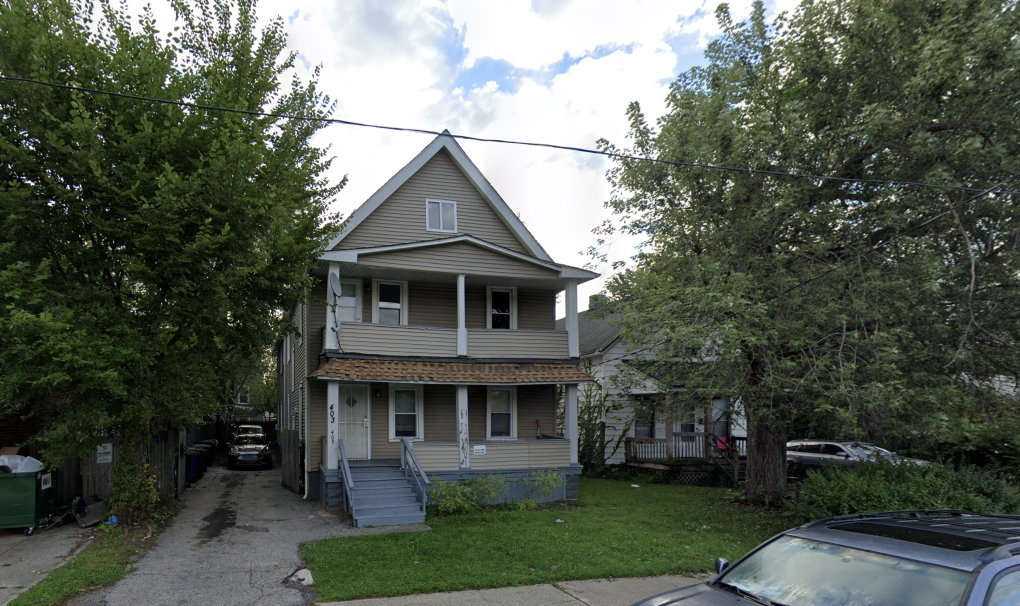
Detective #1 prepared and served a search warrant at 403 E. 152nd Street. A limited amount of information was obtained from Artificial Intelligence and that was not shared with the judge that signed the search warrant.
Search Warrant
On February 20, 2024, Detective #1 presented a proposed search warrant to a Cuyahoga County Common Pleas Court judge (“issuing judge”). In the warrant affidavit, Detective #1 averred the following:
[H]e has reasonable cause to believe and does believe, that within the premises described as . . . 403 E 152nd Street, Apartment #1, City of Cleveland, Cuyahoga County, Ohio . . . there is now being unlawfully kept, concealed and possessed the following . . . any and all evidence pertaining to the violations of the State of Ohio, to wit: R.C. 2903.01 Aggravated murder, R.C. 2903.02 Murder.
The warrant affidavit lists the facts upon which Detective #1 based his beliefs. Those, in relevant part, are the following:
- Affiant avers that he, along with other members of the Homicide unit, as well as the RTCC analyst, were able to view RTCC video and located the victim on video February 14, 2024.
- Affiant avers that upon reviewing the surveillance video they observe the victim exiting the plasma center located at E 156th and Lakeshore Blvd at 1900hrs.
- Affiant avers that the victim walks west on Lakeshore Blvd and continues south on E 152nd Street.
- Affiant avers that a male walks from in between the apartment buildings located at 375 and 371 E 152nd Street and begins walking in front of the victim.
- Affiant avers that in the area of 403 E 152nd Street, the unidentified male walks into a driveway located on the east side of the street, the same side the victim was still walking south on and allows the victim to pass by him.
- Affiant avers that the unidentified male then begins walking behind the victim as they continue south on E 152nd Street.
- Affiant avers that the unidentified male, wearing a dark colored Adidas sweatshirt and dark colored Adidas pants, approached the victim from the back as they neared Upton Avenue.
- Affiant avers that the unidentified male suspect then produced a firearm and pointed it at the side of the victim while holding onto the victim with his other hand.
- Affiant avers the suspect male then shot the victim twice and the victim fell to the ground at which time the suspect begins running north on E 152nd Street.
- Affiant avers that the suspect ran south on E 152nd Street and then went northeast onto Shiloh Avenue. The victim then gets up from the ground and continues walking south on E 152nd Street and is believed to have walked to his residence located at 15704 School Avenue.
- Affiant avers that the suspect returned to the scene of the shooting approximately five (5) to ten (10) minutes later after having changed his pants and appeared to be looking for something on the ground.
- Affiant avers that the suspect is then observed walking back and then running towards the address of 403 E 152nd Street.
- Affiant avers that on February 20, 2024, while watching live video of 403 E 152nd Street, believed to be the address where the unidentified suspect ran into, he observed a male matching the description of the suspect walking from the area of 403 E 152nd Street and continue to the store located at 15208 Lakeshore Blvd. This male having the same build, hair style, clothing and walking characteristics as observed on the suspect on February 14, 2024.
- Affiant avers that he, along with other members of the homicide unit, as well [as] the Cleveland Division of Police video specialist, Tom Cuila, responded to the Lake shore food Market at 15208 Lakeshore Blvd and downloaded surveillance video showing the suspect male enter the store at approximately 1053hrs.
- Affiant avers that utilizing the Fusion center they received an identification of the, as of yet, unidentified male suspect, based on the recovered surveillance video, and it was learned this male was currently paroled to the address of 403 E 152nd Street, Apartment #1.
- Affiant avers that this same male suspect was observed, in real time, on February 20, 2024, exiting and re-entering the front (west) entrance of 403 E 152nd Street, located at the northeast corner of the dwelling.
Note: Detective #1’s name is identified in the case but is redacted in this article.
Search Warrant is Signed and Executed
The issuing judge signed the warrant on the same day. On February 21, 2024, officers executed the search warrant on the Apartment. During the search, officers recovered a Taurus 9 mm firearm, a black Adidas jumpsuit, black and white Nike Dunks, several cell phones, and additional items. Officers also found and arrested Mr. Tolbert, who made statements to the police.
Mr. Tolbert is Indicted
Thirteen Counts
On March 1, 2024, a Cuyahoga County Grand Jury indicted Mr. Tolbert on a total of 13 counts related to the February 14, 2024 homicide. These charges included aggravated murder, three counts of murder, three counts of kidnapping, two counts of felonious assault, two counts of aggravated robbery, having weapons while under disability, and tampering with evidence, all with multiple specifications.
Mr. Tolbert Files a Motion to Suppress
Search Warrant was Misleading
On November 13, 2024, after multiple pretrials and the exchange of discovery, Mr. Tolbert filed a motion to suppress all evidence collected during the February 21, 2024 execution of the search warrant on the Apartment. In the motion to suppress, Mr. Tolbert first argued that paragraph 20 of the warrant affidavit was a false or misleading statement or omission because it states that “utilizing the Fusion [C]enter they received an identification,” while the Northeast Ohio Regional Fusion Center disclaimer states that “[T]hese search results are not intended or permitted to be used as admissible evidence in a court of law or any court filing.”
Running Towards versus Running Into
Second, he argued that “any person or magistrate reading the affidavit would believe that the Fusion [C]enter identified the defendant based on the recovered surveillance video.” Next, Mr. Tolbert argued that paragraph 17 was misleading because it states that the male suspect is observed walking back and then running towards the address of 403 E. 152nd Street, but it does not say he is seen going into the dwelling at that address. He argues that the assumption is that the male suspect is running towards that address but that the video does not show that he ran into the dwelling at 403 E. 152nd Street. Lastly, Mr. Tolbert’s motion argued that the warrant affidavit included undisclosed inferences because it withheld the disclaimer and affirmatively claimed an identification was made by the Fusion Center.
Clearview AI Disclaimer
Daubert Standard
The report that detectives obtained from the Fusion Center, which utilizes Clearview AI facial recognition technology as an investigative tool, included the following disclaimer:
DISCLAIMER: Facial recognition search results are to be treated as investigative leads and should not be solely relied upon for making an arrest. Investigators are required to conduct thorough investigations, independently verify identifications, and adhere to applicable laws and agency policies regarding facial recognition search results. The information in this document is for internal use only and should not be shared outside the user’s agency. These search results are not intended or permitted to be used as admissible evidence in a court of law or any court filing.
Mr. Tolbert’s motion to suppress requested that the trial court hold a hearing pursuant to Franks v. Delaware, 438 U.S. 154 (1978), and Daubert v. Merrell Dow Pharmaceuticals, Inc., 509 U.S. 579 (1993).
Motion to Suppress Hearing
On January 9, 2025, the trial court conducted a Franks hearing on Mr. Tolbert’s motion to suppress. Detective #1 testified regarding the warrant affidavit and the homicide investigation. He stated that he has been with the Cleveland Police Department for 29 years and has been a homicide detective since 2018.
Video of Mr. Story’s Murder
Detective #1 testified that the investigation into Mr. Story’s murder included the review of video from the City of Cleveland’s Real-Time Crime Center’s (“RTCC”) system cameras to track Mr. Story’s movements on the day of his murder. Detectives were able to observe video footage of Mr. Story prior to his murder walking along Lakeshore Boulevard and then turning onto E. 152nd Street. The footage then shows an unknown male wearing a dark-colored jogging suit appear near 403 E. 152nd Street. This male is first seen walking in front of Mr. Story, before turning and walking up the driveway of 403 E. 152nd Street, towards the front of the dwelling, then the male can be seen returning to the street and walking behind Mr. Story before shooting him. After shooting Mr. Story, the male suspect retreats back toward the area of 403 E. 152nd Street. Five to ten minutes later, the RTCC video footage shows the male suspect appear from the front yard area of 403 E. 152nd Street and return to the scene of the homicide. Detective #1 testified that after viewing the RTCC video footage, detectives identified the unknown male as their suspect.
Clearview AI Identifies a Lead
Detective #1 further testified that the area around 403 E. 152nd Street became the primary area of interest and Cleveland police detectives focused on monitoring RTCC live cameras in that area. One week after the shooting, detectives watching a live street-camera feed observed a male suspect, with similar build, hairstyle, clothing, and gait to the shooter, leave the area of 403 E. 152nd Street and go to a store on Lakeshore Boulevard. Detectives obtained surveillance video of the male suspect from the Lakeshore Boulevard store. They sent still images of the male suspect taken from the store’s video to the Fusion Center. The Fusion Center produced a lead that the male suspect captured in the still images was Mr. Tolbert. Detectives learned that Mr. Tolbert was paroled to the Apartment, i.e., 403 E. 152nd Street, Apartment #1.
On February 20, 2024, detectives observed the male suspect, now believed to be Mr. Tolbert, exit and reenter the front entrance of the Apartment. Detectives also compared the still images obtained from the Lakeshore Boulevard store video to other images of Mr. Tolbert to independently verify that their male suspect was indeed Mr. Tolbert.
A supplementary police report dated February 21, 2024, signed by Detective #1, offers additional information regarding the investigation. It explains that detectives learned that the front entrance of 403 E. 152nd Street opens directly into the Apartment. It also clarifies that on February 20, 2024, when police observed the male suspect exit and reenter the Apartment, he appeared to be taking out the trash.
Mr. Tolbert argued that the Fusion Center disclaimer should have been disclosed with the warrant affidavit.
Mr. Tolbert made additional arguments at the suppression hearing in addition to the arguments made in his motion to suppress. First, he argued that the warrant affidavit is not clear as to which video was used to make the identification in paragraph 20. Second, Mr. Tolbert argued that the Ohio Law Enforcement Gateway’s report did not show the Apartment as the address he was paroled to, as averred in paragraph 20. Third, Mr. Tolbert argued that the Fusion Center disclaimer should have been disclosed with the warrant affidavit. Lastly, Mr. Tolbert argued that the warrant affidavit did not disclose that the male suspect is not seen going into and out of 403 E. 152nd Street on February 14, 2024, the day of the homicide, but that he is seen entering and exiting 363 E. 152nd Street that night.
At the conclusion of the hearing, the trial court suppressed all evidence obtained during the search of the Apartment.
At the conclusion of the hearing, the trial court suppressed all evidence obtained during the search of the Apartment. These items included a Taurus 9 mm firearm, a black Adidas jumpsuit, black and white Nike Dunks, several cell phones, and additional items. The trial court stated the following regarding Mr. Tolbert’s motion to suppress:
All right. Having signed I’m sure hundreds of search warrants, some can be misleading. Sometimes the affiant will misstate the gender for instance of an informant just to throw things off. I’ve seen that hundreds of times. That’s not the case here. What we’ve got here is a judge being handed an affidavit saying that we have — I have what’s called an anonymous informant here. And that certainly throws out a search warrant if you have an anonymous informant that you want to find out who it is. And the Fusion Center, I don’t know what judge — how much [the judge] knew about it. But if this would have said — this affidavit or this information that we got was admittedly unreliable by the person who is giving you this information, that would throw up a red flag. That of course would. What I was interested in here is they had to put in the fact — the prosecutor — that the individual they’re looking at was on parole. That’s a little poison that they throw in there in this case. Important, I don’t know. But I’m going to suppress this search warrant and exclude the evidence resulting from the execution of the warrant.
State of Ohio Appeals
In the sole assignment of error, the State argues that the trial court erred when it sustained Mr. Tolbert’s motion to suppress evidence obtained during the execution of the search warrant on the Apartment. The State contends that there was probable cause for the issuance of the search warrant and that contrary to Mr. Tolbert’s arguments, no false statements, omissions, or improper undisclosed inferences were made in the warrant affidavit.
Crim.R. 41(C)(1) provides:
A search warrant shall issue on either an affidavit or affidavits sworn to before a judge of a court of record or an affidavit or affidavits communicated to the judge by reliable electronic means establishing the grounds for issuing the warrant. In the case of a search warrant, the affidavit shall name or describe the person to be searched or particularly describe the place to be searched, name or describe the property to be searched for and seized, state substantially the offense in relation thereto, and state the factual basis for the affiant’s belief that such property is there located.
Established Case Law – Search Warrants
Generally, “search warrants may only be issued upon probable cause, supported by oath or affirmation, particularly describing the place to be searched, and the persons or things to be seized.” State v. Jones, 2015-Ohio-483, ¶ 11-12. ‘“[T]he term “probable cause,” according to its usual acceptation, means less than evidence which would justify condemnation . . . . It imports a seizure made under circumstances which warrant suspicion.’” Illinois v. Gates, 462 U.S. 213, 235 (1983), quoting Locke v. United States, 11 U.S. 339, 348 (1813). ‘“To establish probable cause to search a home, the facts must be sufficient to justify a conclusion that the property that is the subject of the search is probably on the premises to search.’” State v. Marler, 2009-Ohio-2423, ¶ 26 (2d Dist.), quoting State v. Freeman, 2006- Ohio-5020, ¶ 13 (4th Dist.).
Established Case Law – Stale Probable Cause State v. Castagnola
When determining whether to issue a search warrant, the deciding judge or magistrate considers “how stale the information relied upon is, when the facts relied upon occurred, and whether there is a nexus between the alleged crime, the objects to be seized, and the place to be searched.” State v. Castagnola, 2015- Ohio-1565, ¶ 34, citing 2 LaFave, Search and Seizure, § 3.1(b), 3.7(a), (b), and (d) (5th Ed. 2012).
Established Case Law – Jones v. United States
Search Warrant
Basis of Probable Cause
The United States Supreme Court outlined the standard for a court approving a search warrant:
The task of the issuing magistrate is simply to make a practical, common-sense decision whether, given all the circumstances set forth in the affidavit before him, including the “veracity” and “basis of knowledge” of persons supplying hearsay information, there is a fair probability that contraband or evidence of a crime will be found in a particular place.
Jones v. United States, 362 U.S. 257, 271 (1960); State v. George, 45 Ohio St.3d 325, 329 (1989) (following and quoting Jones).
Established Case Law – Franks v. Delaware, 438 U.S. 154 (1978)
Search Warrant False Statements
In Franks v. Delaware, 438 U.S. 154 (1978), the United States Supreme Court addressed whether a defendant could challenge the veracity of a sworn statement made by police when procuring a search warrant. The court ultimately found that where the defendant makes a substantial preliminary showing that a false statement knowingly and intentionally, or with reckless disregard for the truth, was included by the affiant in the warrant affidavit, and if the allegedly false statement is necessary to the finding of probable cause, the Fourth Amendment requires that a hearing be held at the defendant’s request. In the event that at that hearing the allegation of perjury or reckless disregard is established by the defendant by a preponderance of the evidence, and, with the affidavit’s false material set to one side, the affidavit’s remaining content is insufficient to establish probable cause, the search warrant must be voided and the fruits of the search excluded to the same extent as if probable cause was lacking on the face of the affidavit. Franks at 155-156. “There is . . . a presumption of validity with respect to the affidavit supporting [a] search warrant.” Franks at 171. “‘Reckless disregard’ means that the affiant had serious doubts of an allegation’s truth.” State v. Waddy, 63 Ohio St.3d 424, 441 (1992), citing United States v. Williams, 737 F.2d 594, 602 (7th Cir. 1984). “Omissions count as false statements if ‘designed to mislead, or . . . made in reckless disregard of whether they would mislead, the [issuing judge.]’” Id., quoting United States v. Colkley, 899 F.2d 297, 301 (4th Cir. 1990). “Before an omission can be considered material, the defendant must show that the omission would have materially influenced the magistrate such that if the omission had been included in the affidavit it would have negated probable cause for issuance of the warrant.” State v. Wilhelm, 1983 Ohio App. LEXIS 14912, *3-4 (6th Dist. Sept. 2, 1983).
Trial Court Error – The trial court never made findings regarding whether Detective #1 made any knowingly, intentionally false statements or made false statements with reckless disregard for the truth.
The first step under a Franks analysis is to determine whether Detective #1 made a false statement knowingly and intentionally, or with reckless disregard for the truth, in the warrant affidavit. If the court determines that a false statement was made, the second step under a Franks analysis is determining whether the warrant affidavit still establishes probable cause after excising the portions that contain the false statement.
The trial court never made findings regarding whether Detective #1 made any knowingly, intentionally false statements or made false statements with reckless disregard for the truth. Nor did the trial court determine whether the search warrant affidavit’s remaining content is sufficient to establish probable cause. See State v. Kiraly, 2009-Ohio-4714, ¶ 23 (8th Dist.). Therefore, we reverse the decision of the trial court and remand the matter for these determinations.
Undisclosed Inferences
Mr. Tolbert also argues that pursuant to Castagnola, 2015-Ohio-1565, “to withhold the [Fusion Center] disclaimer from the [issuing judge] and to affirmatively claim an identification was made by the Fusion Center is clearly usurping the [issuing judge’s] function.”
In Castagnola, the Ohio Supreme Court considered whether a search- warrant affiant’s undisclosed evidentiary inference stated as an empirical fact usurped the inference-drawing authority of the magistrate who issued the warrant in reliance on the affidavit. The suspect in Castagnola was being investigated for retaliation, criminal trespassing, criminal damaging, and possession of criminal tools and was recorded stating he searched for the victim’s address in court records. The detective that authored the warrant affidavit inferred that an “online” search was done on the suspect’s computer rather than on his smart phone. This inference was never communicated to the warrant issuing judge who signed a search warrant allowing a search of the suspect’s computer. The suspect was later charged with ten counts of pandering sexually oriented material after a search revealed the computer contained evidence of child pornography.
[T]he magistrate must be afforded the opportunity to test any significant inference drawn by the affiant.
The Ohio Supreme Court sustained the suppression of evidence found on the computer during the search, finding that courts have recognized that affidavits that include a factual narrative will inevitably include a number of inferences drawn by the affiant. People v. Caffott, 105 Cal.App.3d 775, 782 (1980). However, “[T]he magistrate must be afforded the opportunity to test any significant inference drawn by the affiant.” People v. Smith, 180 Cal.App.3d 72, 87 (1986). The facts upon which those inferences are based must be disclosed to permit a magistrate’s independent review. State v. Bean, 13 Ohio App.3d 69, 74, 468 N.E.2d 146 (6th Dist.1983). See also State v. Garza, 2013-Ohio-5492, 5 N.E.3d 89, ¶ 25 (3d Dist.). Castagnola at ¶ 40.
Castagnola Court also noted that “affiants may make reasonable inferences within search-warrant affidavits.”
The Castagnola Court also noted that “affiants may make reasonable
inferences within search-warrant affidavits.” Castagnola, 2015-Ohio-1565, at ¶ 39. The Court adopted the test laid out in Caffott, 105 Cal.App.3d 775:
“[D]etermine whether the hidden inference was so significant as to cross the line between permissible interpretation and usurpation. … A hidden inference should be deemed significant if it can be fairly concluded that it had a substantial bearing on the magistrate’s determination of probable cause in each of two respects:
(1) Relevance: The more directly relevant the inference is to the magistrate’s inquiry, the more substantial its bearing and the more significant it will be. * * *
(2) Complexity: The more complex and attenuated the logical process by which a relevant conclusion is reached, the more important it is that the magistrate receive an opportunity to test the inference for validity as part of his neutral and detached function. Conversely, an inference so straightforward, and so patently within the affiant’s area of expertise, as to be a matter of “routine interpretation” for the affiant is probably not so significant as to require the magistrate’s review even though the conclusion thus reached is highly relevant.” Castagnola at ¶ 12-13, quoting Caffott at 783.
Paragraph 20 – Identification was made by the Fusion Center
Mr. Tolbert argues there are two inferences that were made by Detective #1. First, he argues Detective #1’s failure to include the disclaimer from the Fusion Center with the warrant affidavit usurped the issuing judge’s function. The second inference Mr. Tolbert argues should have been disclosed to the issuing judge is in paragraph 20 of the warrant affidavit, which claims an identification was made by the Fusion Center. Mr. Tolbert argues that the Fusion Center report was a lead that stated that Mr. Tolbert was a “likely match” to the male suspect, but the inference is that there was a “positive identification” that Mr. Tolbert was the male suspect.
Case is Reversed and Remanded for Further Determinations
The trial court never made any findings regarding the significance, and specifically the relevance or complexity, of the undisclosed inferences. Therefore, we reverse the decision of the trial court and remand the matter to the trial court for these determinations.
Conclusion and Holding
For the reasons stated above, we reverse the trial court’s decision and remand for further proceedings consistent with this opinion.
Information for this article was obtained from State v. Tolbert, 2025 – Ohio – 4469 and the below news article:
State v. Tolbert, 2025 – Ohio – 4469 was issued on September 25, 2025 and is binding in Cuyahoga County, Ohio.
Lessons Learned:
- What Does the Court Holding Mean? The Eighth District Appellate Court determined that the trial court judge made several errors when he suppressed the evidence in the case against Mr. Tolbert. Based on the errors explained below, the appellate court sent the case back to the trial court to make several determinations centering on the use of Artificial Intelligence.
- Should Good Faith Doctrine be Applied? On July 5, 1984 the U.S. Supreme Court issued U.S. v. Leon, 468 U.S. 897 (1984) that established the Good Faith Doctrine “[W]e believe, when an officer acting with objective good faith has obtained a search warrant from a judge or magistrate and acted within its scope an officer cannot be expected to question the magistrate’s probable cause determination or his judgment that the form of the warrant is technically sufficient. Once the warrant issues there is literally nothing more the policeman can do in seeking to comply with the law. Penalizing the officer for the magistrate’s error, rather than his own, cannot logically contribute to the deterrence of Fourth Amendment violations.” Thereafter the court established four exceptions to this holding; one of which is “The issuing magistrate was misled by information in the affidavit that the affiant [law enforcement officer] knew was false or would have known was false except for his reckless disregard for the truth.”. This exception is applied to the Clearview AI disclaimer that states in pertinent part “Facial recognition search results are to be treated as investigative leads and should not be solely relied upon for making an arrest … These search results are not intended or permitted to be used as admissible evidence in a court of law or any court filing.
- Search Warrant Inferences – On April 28, 2015 the Supreme Court of Ohio issued State v. Castagnola, 2015- Ohio-1565 that states in pertinent part “[D]etermine whether the hidden inference was so significant as to cross the line between permissible interpretation and usurpation. … A hidden inference should be deemed significant if it can be fairly concluded that it had a substantial bearing on the magistrate’s determination of probable cause.” In this case paragraph twenty of the affidavit was challenged under the Castagnola holding “ Affiant avers that utilizing the Fusion center they received an identification of the, as of yet, unidentified male suspect, based on the recovered surveillance video, and it was learned this male was currently paroled to the address of 403 E 152nd Street, Apartment #1.” The Eighth District Court concluded “The trial court never made any findings regarding the significance, and specifically the relevance or complexity, of the undisclosed inferences. Therefore, we reverse the decision of the trial court and remand the matter to the trial court for these determinations.”.
- Trial Court Failed to Hold a Franks Hearing – On June 26, 1978 the U.S. Supreme Court issued Franks v. Delaware, 438 U.S. 154 (1978). In that case the United States Supreme Court addressed whether a defendant could challenge the veracity of a sworn statement made by police when procuring a search warrant. In this case the Eighth District Appellate Court opined “The trial court never made findings regarding whether Detective #1 made any knowingly, intentionally false statements or made false statements with reckless disregard for the truth. Nor did the trial court determine whether the search warrant affidavit’s remaining content is sufficient to establish probable cause.”. Because there was no Franks hearing the case was remanded [sent back] to the trial court to make several determinations on the use and application of the Clearview AI information and what was independently obtained and analyzed by Detective #1.
- Current and Future Use of Artificial Intelligence – Artificial intelligence is changing our world both in our personal and professional lives. AI is going to be another positive step in preventing and solving crimes but some of the information is not yet so reliable as to be acceptable in court. Law enforcement officers must be fully transparent with the court whenever AI-generated information is used to evaluate facts or establish probable cause for a warrant.
Does your agency train on Search Warrants?
Don’t fail your training.
Don’t let your training fail you!
Be safe, smart and objectively reasonable!