
Nor are there contextual factors that make this canine alert unreliable. There may come a day when hemp or other legal cannabis substances are so pervasive that the alert of a canine trained to identify the smell of marijuana, but not to distinguish between legal and illegal forms of cannabis, no longer tends to indicate a “fair probability” of contraband. Illinois v. Gates, 462 U.S. 213, 238 (1983). Based on the sparse record before us in this case, that day is not today.
U.S. v. Saine
Sixth Circuit Appellate Court
December 22, 2025
Why is This Case Important?
U.S. v. Saine underscores the enduring importance of the totality-of-the-circumstances analysis. The canine alert did not stand alone. It was supported by officer experience, a BOLO for narcotics trafficking, and the encounter occurring at a known drug-activity location. Together, these factors satisfied the Fourth Amendment probable cause standard.
Background
Ricco Saine was convicted of two counts of knowingly possessing a firearm as a convicted felon. On appeal, he challenges his conviction on two grounds: First, he argues the district court erroneously denied his motion to suppress evidence seized from his truck following a search based on a drug dog’s positive alert. Second, he argues the district court erred by admitting a text message because it is improper propensity evidence. We disagree and affirm Mr. Saine’s conviction.
Drug Dog Alert
Officer Bates’s canine was not trained to distinguish “between legal cannabis and marijuana.”
The relevant facts we recount here are not in dispute. In August 2021, Kingsport Police Officer Aaron Blevins approached Ricco Saine while Mr. Saine was next to his truck at the Westside Inn, 1017 West Stone Drive, Kingsport, Tennessee. Because a Be on the Lookout (BOLO) alert indicated Mr. Saine was suspected of narcotics trafficking and because Officer Blevins believed the Westside Inn was a “known drug location,” Officer Blevins called for a canine unit. Officer Travis Bates arrived roughly ten minutes later with his canine, who is certified to detect methamphetamine, cocaine, heroin, and marijuana. Officer Bates’s canine was not trained to distinguish “between legal cannabis and marijuana.” Tennessee, where the search took place, criminalizes possession of marijuana, see, e.g., Tenn. Code Ann. § 39-17- 417(g), but not hemp, id. § 39-17-402(16)(C), or certain byproducts of the marijuana plant, id. § 39-17-402(16)(B), (E).
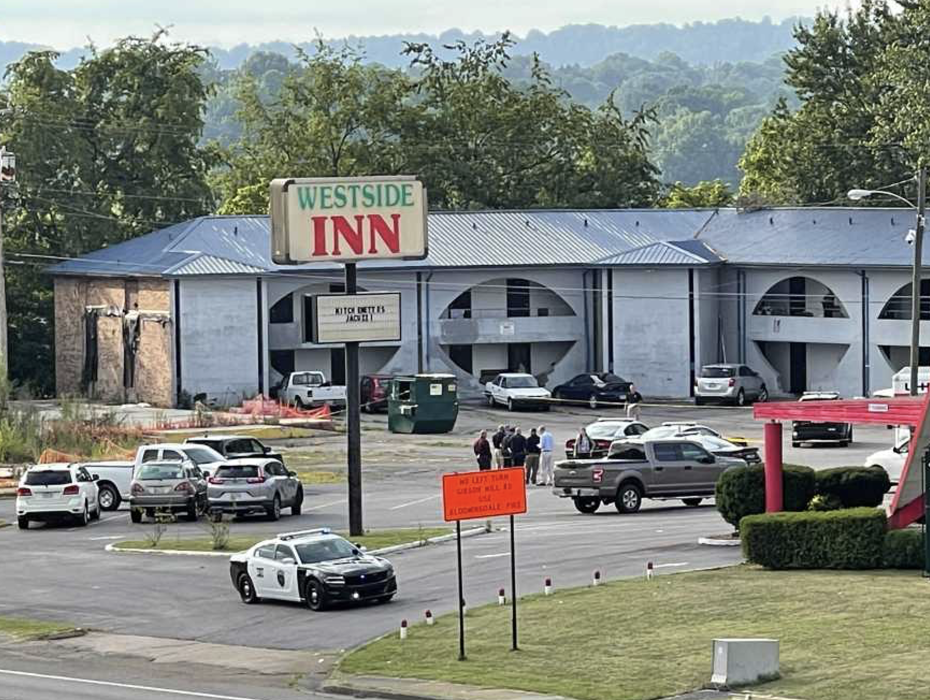
Westside Inn, 1017 West Stone Drive, Kingsport, Tennessee. This motel has since been torn down.
Canine Alert
Officer Bates’s canine alerted next to the driver’s side rear door. Following this alert, officers searched Mr. Saine’s truck. They found a “small amount of what appeared to be marijuana,” but the record does not establish the substance’s actual identity. They also found an unzipped bag containing a firearm, identified as a Ruger EC9S, 9mm semiautomatic pistol (the Ruger), alongside Mr. Saine’s ID.
Video of a Straw Purchase?
A few weeks later, Officer Mike Slater went to the home of Mr. Saine and Ms. Tonya Saine. Mr. Saine was not present. While there, Officer Slater photographed three firearms which Tonya claimed she owned: a Walther, model PK380, .380 caliber pistol (the Walther); a Springfield Armory, model Saint, 5.56 caliber rifle (the Springfield); and a second pistol. Officer Slater later obtained surveillance video footage which showed Tonya purchasing the Walther and the Springfield from a local gun store while with Mr. Saine.
Whose Gun?
I’ve got your gun and stuff in the house.
Roughly a month after the police discovered these guns, Mr. Saine was arrested on unrelated charges. While in police custody, he tried to make a deal with Officer Slater. He offered to tell Tonya “to hand over his AR-15” if Officer Slater agreed to vouch for his release. Around this same time, the police seized both the Walther and the Springfield from Tonya. Executing a search warrant, the police also acquired Mr. Saine’s cellphone and downloaded its data. This data included a text conversation between Mr. Saine and Tonya featuring the following exchange:
Tonya: “I’ve got your gun and stuff in the house”
Mr. Saine: “K”
These messages were sent eight days after Tonya purchased the Walther and the Springfield.
Your Gun Results in Criminal Charges
The government charged Mr. Saine with two counts of unlawfully possessing a firearm as a convicted felon. See 18 U.S.C. §§ 922(g)(1), 924(e)(1). In one count, it charged Mr. Saine with possessing the Ruger found in his truck outside the Westside Inn. In the other, it charged him with possessing both the Walther and the Springfield discovered at his and Tonya’s home.
Motion to Suppress
[H]e questioned whether the canine could differentiate between legal substances, like hemp, and illegal marijuana substances.
Mr. Saine moved the district court to suppress the Ruger, arguing that the police uncovered it through an unconstitutional search of his truck. His motion to suppress primarily focused on whether the police were justified in calling for a canine unit in the first place, though he does not renew this argument on appeal. At the suppression hearing, he questioned whether the canine could differentiate between legal substances, like hemp, and illegal marijuana substances. Mr. Saine presses this argument now.
Mr. Saine did not provide any caselaw indicating that a canine alert is unreliable when the dog cannot distinguish between legal cannabis and illegal marijuana.
The district court rejected Mr. Saine’s argument that the canine’s inability to differentiate between hemp and illegal marijuana rendered the search unconstitutional. It reasoned that Florida v. Harris, 568 U.S. 237 (2013), held that the alert of a drug sniffing dog is presumptively sufficient for probable cause, and it noted that Mr. Saine did not provide any caselaw indicating that a canine alert is unreliable when the dog cannot distinguish between legal cannabis and illegal marijuana. After the district court denied his motion to suppress, Mr. Saine’s case proceeded to trial.
The jury returned a guilty verdict on both counts.
Appeal – Law Enforcement Did Not Establish Probable Cause
Mr. Saine challenges his conviction on two grounds. First, Mr. Saine argues that the district court erred when it declined to suppress the Ruger because the police did not have probable cause to search his truck even after the positive alert from the canine.
Established Case Law – Canine Probable Cause
When reviewing a district court’s order denying a motion to suppress, we review factual findings for clear error and conclusions of law de novo. United States v. Stevenson, 43 F.4th 641, 644 (6th Cir. 2022). Officers may search a car without a warrant if they have probable cause to believe it contains evidence of criminality. Hernandez v. Boles, 949 F.3d 251, 259 (6th Cir. 2020). In Florida v. Harris, the Supreme Court held that a canine’s positive alert presumptively supplies probable cause to search a vehicle so long as the government provides evidence that the canine reliably identifies contraband in controlled settings. 568 U.S. at 248.
Mr. Saine relies on the fact that the canine in this case could not distinguish between hemp—which is legal in Tennessee—and illegal marijuana.
At issue here is whether Harris’s presumption that a canine’s positive alert provides probable cause still applies with the same force when a state has legalized marijuana, at least in some forms, or other substances, like hemp, whose smells are indistinguishable from marijuana. Mr. Saine argues Harris does not apply here since the canine could not distinguish between legal and illegal substances and Harris depended on the canine’s ability to distinguish between contraband and non-contraband. Mr. Saine relies on the fact that the canine in this case could not distinguish between hemp—which is legal in Tennessee—and illegal marijuana.
[T]he fact that an officer—or a canine—could have merely smelled hemp or another legal cannabis substance does not necessarily negate probable cause.
This argument fails because probable cause determinations focus on probabilities, not certainties. Probable cause does not require officers to eliminate alternative innocent explanations. See United States v. Martin, 289 F.3d 392, 400 (6th Cir. 2002). Rather, it “requires only a probability or substantial chance of criminal activity, not an actual showing of such activity.” District of Columbia v. Wesby, 583 U.S. 48, 57 (2018). So the fact that an officer—or a canine—could have merely smelled hemp or another legal cannabis substance does not necessarily negate probable cause.
We have already held that human officers smelling marijuana can provide probable cause for an arrest, even when certain types of cannabis are legal.
We have already held that human officers smelling marijuana can provide probable cause for an arrest, even when certain types of cannabis are legal. See United States v. Santiago, 139 F.4th 570, 574–75 (6th Cir. 2025). Mr. Saine argues that canines are categorically different from human officers. Specifically, he contends that canines are like a device that provides an automatic response upon smelling certain drugs, while human officers can take account of the surrounding circumstances beyond the smell, and officers can consider other contextual factors in distinguishing between legal and illegal cannabis substances. But the context of a dog sniff always must be considered too. The Supreme Court recognized as much in Harris when it noted that the circumstances of any specific canine alert may make it unreliable. 568 U.S. at 247. Mr. Saine, therefore, has not provided us a persuasive reason to distinguish Santiago here.
Smell of Marijuana Still Establishes a ‘Fair Probability’ to Establish Probable Cause
Nor are there contextual factors that make this canine alert unreliable. There may come a day when hemp or other legal cannabis substances are so pervasive that the alert of a canine trained to identify the smell of marijuana, but not to distinguish between legal and illegal forms of cannabis, no longer tends to indicate a “fair probability” of contraband. Illinois v. Gates, 462 U.S. 213, 238 (1983). Based on the sparse record before us in this case, that day is not today.
Conclusion and Holding
Instead, multiple other factors in this case support our conclusion that Officer Blevins had probable cause to search Mr. Saine’s truck. Officer Blevins testified that the Westside Inn is a “known hot bed of criminal activity,” including drug crimes, based on his experience as an officer. And there was a BOLO alert indicating Mr. Saine was potentially involved in narcotics trafficking. Taking all this together—the canine alert, the location, and the BOLO—the “totality of the circumstances” reflects a fair probability that contraband would be found in Mr. Saine’s truck. Maryland v. Pringle, 540 U.S. 366, 371 (2003). So the officers had probable cause to search it. Thus, the district court did not err when it denied Mr. Saine’s motion to suppress.
Mr. Ricco Saine was sentenced to over twenty-one years in prison. https://www.justice.gov/usao-edtn/pr/ricco-saine-sentenced-262-months-firearms-offense
Note: There was an additional appeal on the admissibility of a text message. That appeal was also denied, though it is not evaluated in this article.
Information for this article was obtained from U.S. v. Saine, No 24 – 5638.
U.S. v. Saine, No 24 – 5638 was issued by the Sixth Circuit Appellate Court and is binding Kentucky, Michigan, Ohio and Tennessee.
Lessons Learned
- Who Smokes Hemp? On June 6, 2025 the Sixth Circuit Appellate Court issued U.S. v. Santiago, No. 24 – 5762. In that case, the court explained how the smell of marijuana still establishes probable cause even with the legalization of hemp as the smell of both marijuana and hemp are so similar. “Santiago objects, saying that the officers could not reasonably have suspected him of any criminal activity because marijuana smells the same as hemp, and hemp is legal in Tennessee. Santiago is right on the facts but wrong on the law. We have already decided that even though illicit marijuana smells like legal hemp, the smell of marijuana still supports a Terry stop. U.S. v. McCallister, 39 F.4th 368, 375 (6th Cir., 2022). As for the arrest, the Supreme Court has made clear that probable cause “does not require officers to rule out” an “innocent explanation for suspicious facts.” District of Columbia v. Wesby, 583 U.S. 48, 56 (2018) So the mere fact that Santiago could have possessed hemp did not negate the officers’ reasonable ground for believing Santiago possessed marijuana. See U.S. v. Bignon, 813 F.App’x 34, 37 (2nd Cir., 2020) (stating that the “probable-cause finding is not undermined by the fact that [the arrestee] repeatedly told the arresting officers that he was smoking hemp, not marijuana”). Indeed, Det. Tidwell and Det. Miller each testified at the suppression hearing that, in the course of performing his duties as a police officer, he had never encountered someone smoking hemp. This background experience would have led a reasonable officer to conclude there was a substantial chance that he smelled marijuana in Santiago’s possession. That Santiago possibly possessed hemp instead doesn’t change that.”.
- What Impact Does both Santiago and now Saine Have on Ohio Canine Sniffs? If a canine is imprinted with cannabis and that canine alerts on a vehicle, does that establish probable cause? Since cannabis possession is now legal in Ohio with some parameters – no more than 2.5 ounces in a car see O.R.C. §3780.36, then a canine alert without more would not establish probable cause. However, if an officer smells burnt marijuana in a vehicle, then I believe that would establish probable cause in all but Hamilton County, Ohio – see Does the Smell of Marijuana Alone Still Establish Probable Cause to Search a Vehicle in Hamilton County, Ohio? – State v. Gray, 2025 – Ohio – 4607. My analysis and conclusion is grounded in the Moore case; on September 20, 2000 the Supreme Court of Ohio issued State v. Moore, 2000- Ohio-10. There the court held “[W]e hold that the smell of marijuana, alone, by a person qualified to recognize the odor, is sufficient to establish probable cause to conduct a search.”. I believe the Moore case now only applies to burnt marijuana and not packaged/raw marijuana. The caveat to this analysis is the recent Sixth Circuit Decisions in U.S. v. Whitlow, No. 24 – 3114 (6th Cir., 2025) and U.S. v. Hinds, Nos 24 – 1704/22-1848 that permits state law enforcement to enforce federal law to include the possession of cannabis see: https://www.law.cornell.edu/uscode/text/21/844 Before state law enforcement enforces ANY federal law, the officer/deputy should consult with both the prosecutor and chain of command. Also see: https://www.objectivelyreasonable.com/2025/04/21/can-a-state-law-enforcement-enforce-a-federal-law/ https://www.objectivelyreasonable.com/2025/09/29/sixth-circuit-appellate-court-reaffirms-that-local-law-enforcement-may-enforce-federal-law/
- Totality of the Circumstances – On June 27, 1949 the U.S. Supreme Court issued Brinegar v. U.S., 338 U.S. 160 (1949). In that case the court gave an oft-quoted definition of probable cause: “In dealing with probable cause, however, as the very name implies, we deal with probabilities. These are not technical; they are the factual and practical considerations of everyday life on which reasonable and prudent men, not legal technicians, act. The standard of proof is accordingly correlative to what must be proved.”. In this case the factual and practical considerations that established probable cause that Mr. Saine possessed marijuana as the court explained “Officer Blevins testified that this particular motel is a “known hot bed of criminal activity,” including drug crimes, based on his experience as an officer. And there was a BOLO alert indicating Mr. Saine was potentially involved in narcotics trafficking. Taking all this together—the canine alert, the location, and the BOLO—the “totality of the circumstances” reflects a fair probability that contraband would be found in Mr. Saine’s truck.”. These factors comport to the U.S. Supreme Court probable cause explanation in Brinegar some seventy-two years later.
- Pre-Sent Arms! Officer Mike Slater, Officer Travis Bates his unnamed canine and the federal prosecutors should all be highly commended for their investigation, conviction and successful appeal defense on Mr. Saine. Well done!
Does your agency train on Probable Cause and Canine Sniffs?
Don’t fail your training.
Don’t let your training fail you!
Be safe, smart and objectively reasonable!